Our house ticks most of the energy transition boxes: an air-source heat pump, solar panels, a plug-in car and modern appliances. All of it is less than two years old, yet none of it is “smart”. At best it keeps a schedule: the car and the heat pump have daily timers, and the appliances have delay buttons.
We buy our electricity on Octopus Agile because we can shift much of our use to cheap hours – trivially so for charging the car and heating the hot water. Ideally our devices would respond to prices on their own and talk both ways to a smart controller, taking us to a hyper-optimised energy nirvana. In practice that would be a major smart home integration project, needing new hardware, faff and beard-scratching.
Are we missing out on much by having such crude controls? I investigated. The figures below are for our house; other homes will differ.
A predictable price
Each day on Agile follows a similar shape.
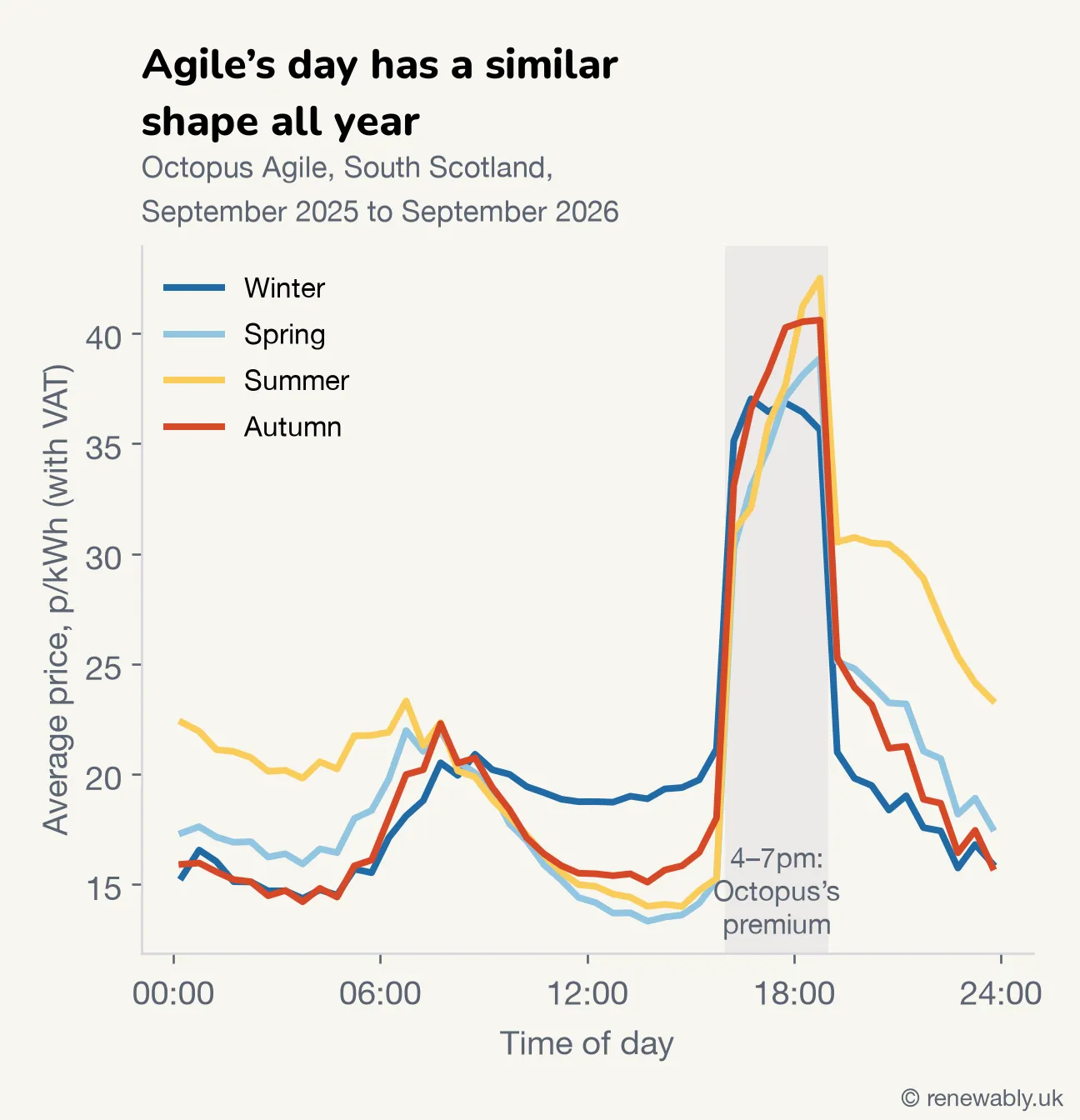
Prices roughly double between 4pm and 7pm in every season, partly because of the market and partly because Octopus adds a fixed premium in those hours (16p per kilowatt hour before VAT in South and Central Scotland, about 12p to 24p elsewhere). The cheapest hours fall overnight in winter and around midday in summer: regular enough for a fixed schedule to catch most of it.
What a schedule achieves
I priced a year of our own use three ways: no effort; what we actually do with our schedules; and a perfectly informed, fully smart theoretical version of our devices that always uses the cheapest hours.
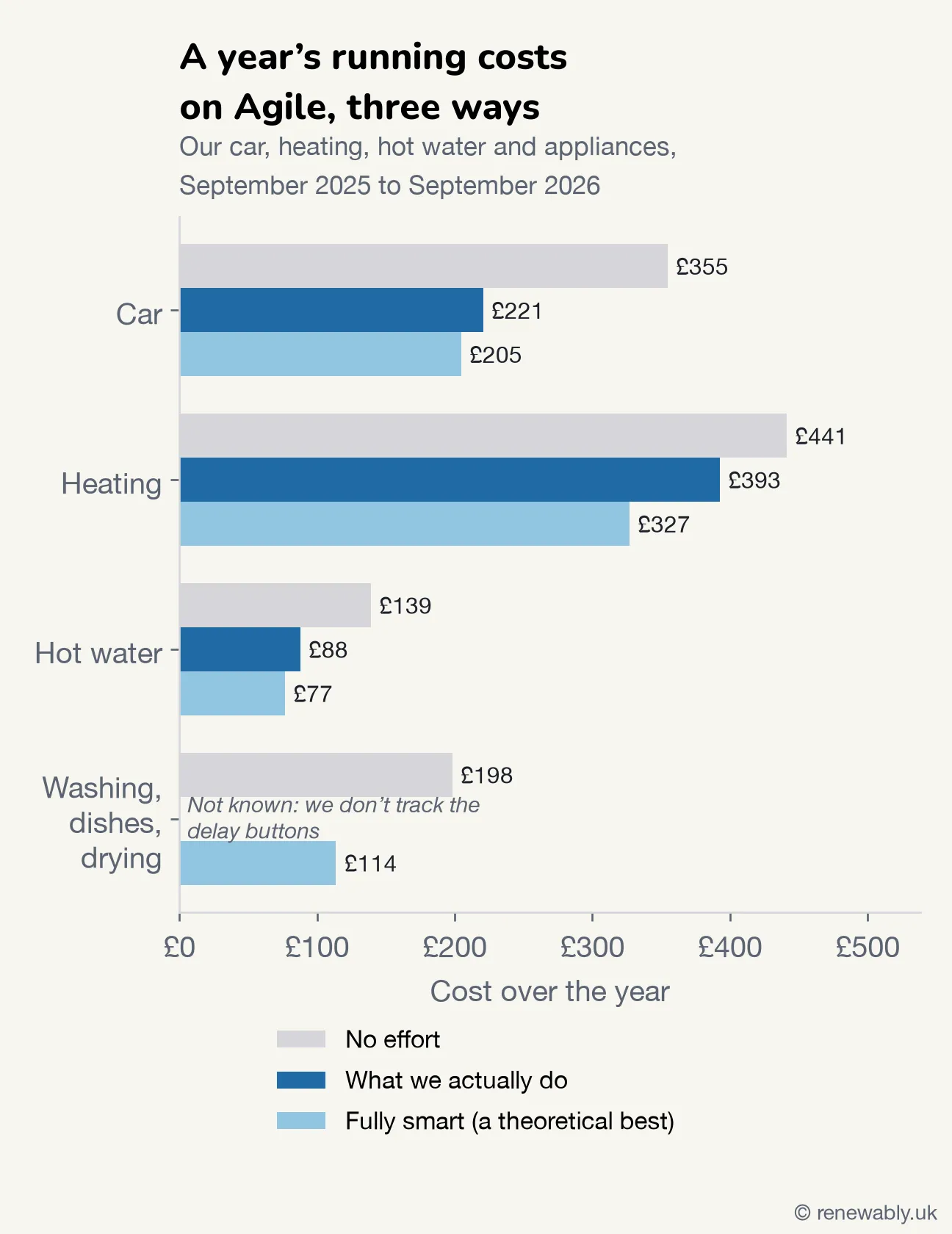
For the car, heating and hot water, naive use would have cost us about £935 over the year. What we actually did with our schedules cost £701, and the perfect smart nirvana could in theory have cost as little as £608. So the “smart gap” was at most about £93.
The car matters most, and is the easiest: one charging schedule does most of the work. Against an Agile average of 20.8p, its electricity cost us 14.9p a kilowatt hour, the heating 17.3p and the hot water 14.8p (working out at around 7p per very generous shower!).
If these totals look cheap, that’s because our solar panels make a big dent in the bills, and I have netted off what we earn from exporting.
How much effort is enough
I make substantial changes to these schedules twice a year, mainly to make the most of our solar panels in summer and of cheap overnight rates in winter. (In practice I tweak and fiddle more often than that, but broadly along those lines.) Is that enough? To find out, I back-tested our actual consumption, choosing each setting on the previous year’s prices and judging it on the next.
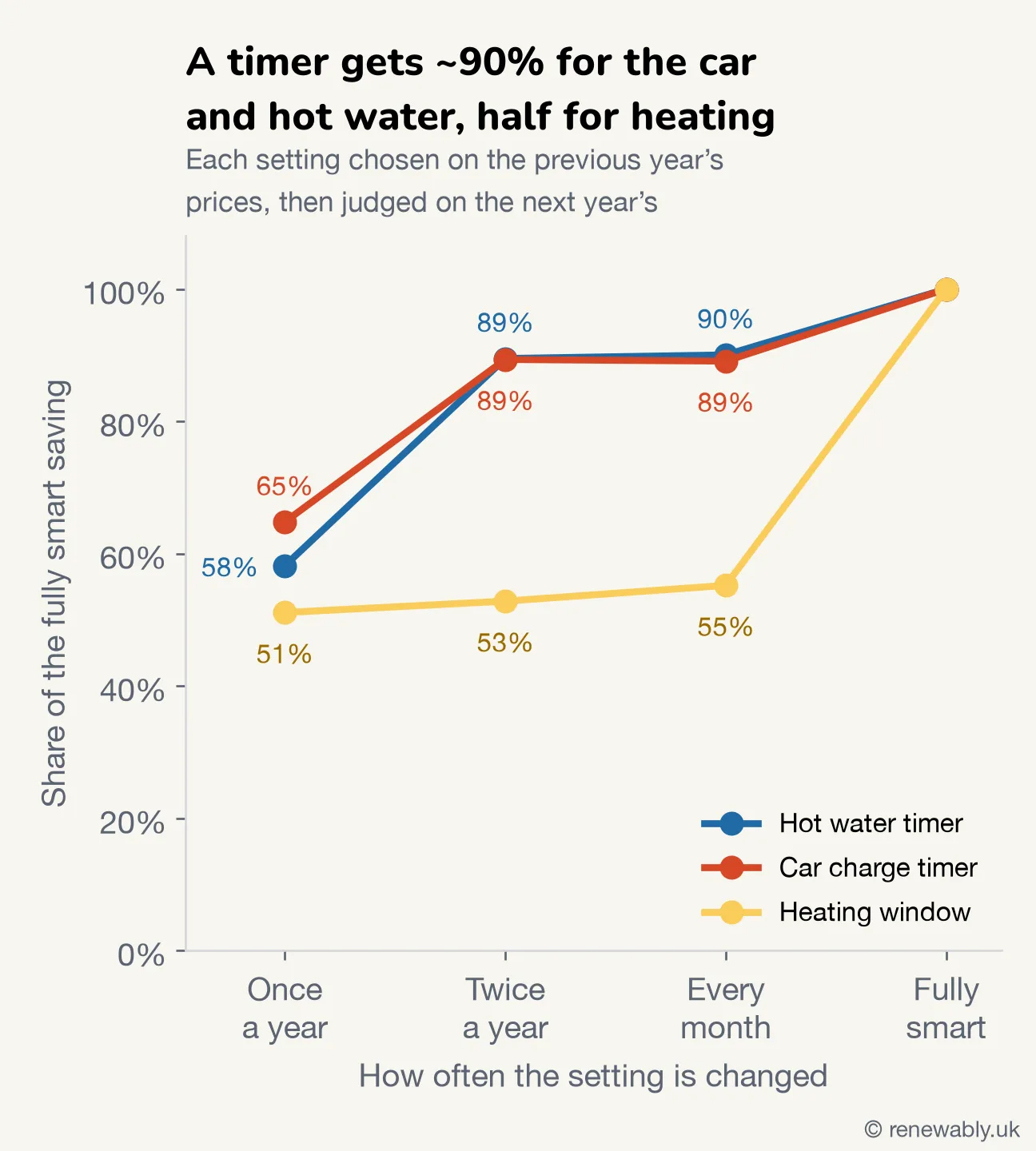
For us, a car-charging or hot-water schedule changed twice a year, when the clocks change, captures close to 90 per cent of what a fully smart system would, and changing them more often gains very little.
Heating is the exception, at about half but treat that with some scepticism. The “smartest” heating modelled here simply fits each day’s actual heat into the cheapest possible hours, ignoring when we actually want the house to be warm. In real life that would mean over- and under-heating through the day, however I couldn’t think of a better way to model it.
Should we pursue “more smartness”?
For us, the backward-looking best case would have saved £93, but that is unattainable. We use the car, so it isn’t always parked on the drive ready to charge, and the heating has to follow our lives rather than be moved around willy-nilly. Without giving up comfort, about £50 a year is probably a more realistic best case so against this modest saving any smart tech would have to be virtually free and extremely simple to setup for this to be cost-effective or worth the fuss!